Plots in Maha Goa: Why Delhi’s Winter Smog Is Quietly Destroying Visibility, Health—and Investment Confidence
On most December mornings, Delhi doesn’t wake up — it fades in.
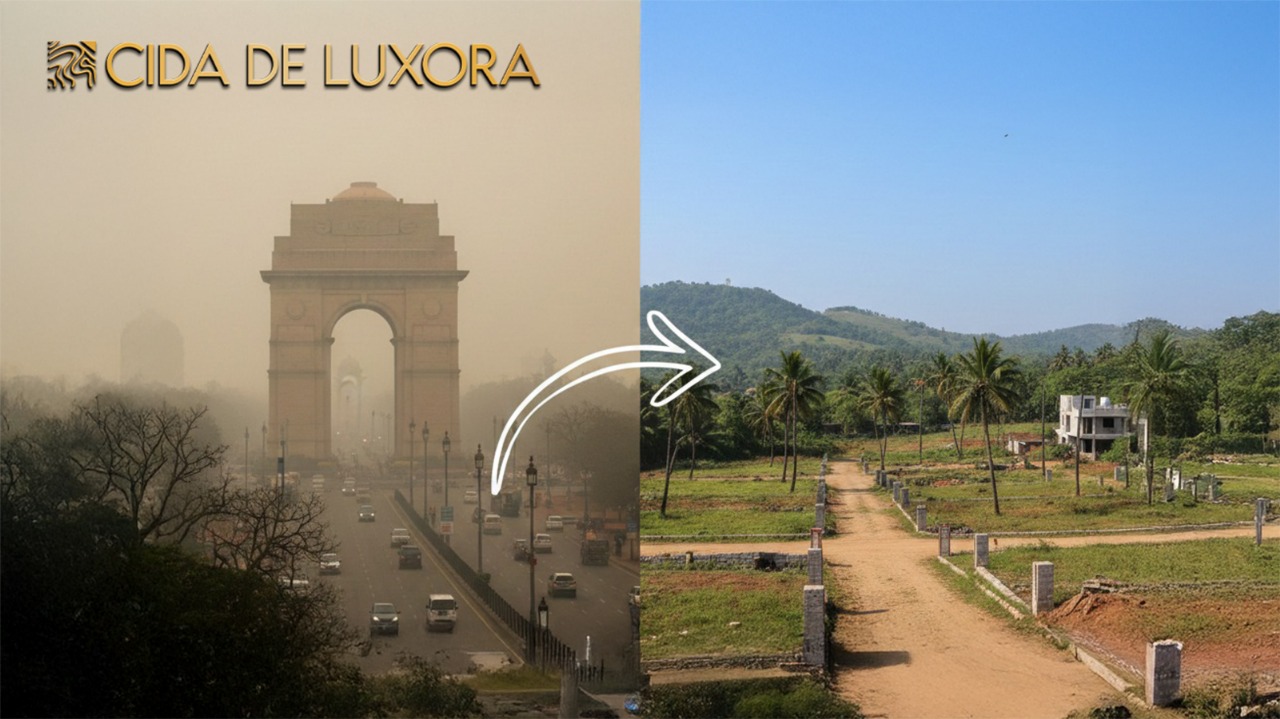
Buildings blur into grey silhouettes. Roads slow into hesitation. Airports operate on contingency. Visibility collapses to under 200 metres, sometimes even 100 metres, according to the India Meteorological Department (IMD). Flights delay, schools shut, construction halts, and outdoor life disappears.
This is no longer a temporary inconvenience. It’s a structural winter reality.
And while air pollution dominates health conversations, something deeper is shifting quietly across India’s high-net-worth households: investment confidence in megacity living is eroding.
That erosion is precisely why plots in maha goa are no longer just lifestyle upgrades — they are becoming strategic land decisions.
Delhi’s Winter Smog Is No Longer a Crisis — It’s a Pattern
For over a decade, Delhi-NCR’s pollution was treated as episodic. Crop burning. Firecrackers. Construction spikes. Temporary fixes.
But official data now tells a different story.
According to the Central Pollution Control Board (CPCB), Delhi consistently records “Very Poor” to “Severe” AQI levels across winter months, with PM2.5 emerging as the dominant pollutant year after year.
The AQI classification is unambiguous:
AQI Category | Impact |
Very Poor (301–400) | Respiratory illness on prolonged exposure |
Severe (401–500) | Serious health impacts even on healthy individuals |
In December 2025, Delhi officially recorded zero “Moderate” AQI days — a milestone that quietly signals the normalization of unhealthy air.
When “acceptable” air disappears from the calendar, long-term lifestyle planning begins to change. This is the exact inflection point where plots in maha goa enter serious investor conversations.
Why Visibility Collapses Every Winter: The Science Behind Delhi’s Smog
Delhi’s winter pollution isn’t just about emissions — it’s about atmospheric physics.
1. Temperature Inversion: The Invisible Lid Over the City
During winter nights, the ground cools faster than the air above it. Cold air settles near the surface, while warmer air remains aloft. This phenomenon, known as temperature inversion, traps pollutants near breathing level.
The India Meteorological Department (IMD) and SAFAR-India (IITM, Ministry of Earth Sciences) consistently cite inversion as a primary winter pollutant amplifier.
2. PM2.5 + Humidity = Smog That Behaves Like Fog
Fine particulate matter (PM2.5) acts as condensation nuclei. When humidity rises and wind speeds drop — common in December — pollution thickens into smog that reduces visibility drastically.
In late December, IMD issued an orange alert, reporting airport visibility dropping to ~100 metres, disrupting aviation schedules and surface mobility.
This isn’t aesthetic inconvenience. This is urban dysfunction.
For families and investors planning decades ahead, these disruptions alter how “liveability” is evaluated — pushing attention toward plots in maha goa, where environmental volatility feels lower and daily life feels less restricted.
When Air Pollution Becomes a Health Equation — Not a Sensation
Pollution anxiety is often dismissed as emotional. Global institutions disagree.
WHO: Air Pollution Is a Leading Risk Factor
The World Health Organization (WHO) confirms that long-term exposure to ambient air pollution increases risks of:
- Ischemic heart disease
- Stroke
- Chronic respiratory illness
- Lung cancer
This elevates pollution from discomfort to chronic health exposure — particularly for children and elderly populations.
As health considerations become non-negotiable, families increasingly look toward plots in maha goa, where open environments allow lifestyle flexibility.
The Economic Cost of Breathing Bad Air
Beyond health, pollution extracts a measurable economic toll.
The World Bank estimates that air pollution costs India over 8% of its GDP annually, factoring in healthcare expenditure, lost labour income, and productivity decline.
When pollution erodes both time and income, asset preferences shift. Investors begin to favor land in lower-density, climate-balanced corridors — particularly plots in maha goa.
Policy Response Confirms the Crisis Is Structural
When pollution spikes, the Commission for Air Quality Management (CAQM) activates the Graded Response Action Plan (GRAP).
GRAP measures include:
- Construction bans
- Diesel vehicle restrictions
- School closures
- Industrial shutdowns
GRAP is not symbolic. It is institutional acknowledgment that normal urban life cannot function under current conditions.
Repeated GRAP activation sends a clear message to long-term investors: this is not a temporary disruption.
As a result, demand is quietly migrating toward land-based assets — especially plots in maha goa, which offer resilience rather than mitigation.

From Air Purifiers to Exit Strategies: The Buyer Psychology Shift
Urban adaptation has limits.
Delhi households now invest heavily in:
- Multi-room HEPA air purifiers
- Sealed living environments
- Restricted outdoor schedules
But the deeper question emerges: Is this sustainable for the next 20 years?
Increasingly, families don’t ask how to survive winters, but where to build alternatives.
This psychological pivot is a major driver behind the rising appeal of plots in maha goa — where life feels less engineered and more breathable.
Why the Maha–Goa Belt Is Being Re-Evaluated by Serious Investors
This isn’t about romantic coastal narratives. It’s about risk distribution.
Coastal and low-density belts often benefit from:
- Better wind circulation
- Lower vehicular congestion
- Fewer industrial clusters
The CPCB AQI dashboard allows anyone to verify real-time air quality across regions.
While no region is pollution-free, seasonal volatility is significantly lower in the Maha–Goa belt than in NCR.
This consistency is exactly why plots in maha goa are now being viewed as defensive lifestyle assets.
Why Plots Matter More Than Apartments in a Polluted Era
Apartments offer limited control.
Plots offer choice.
With plots in maha goa, homeowners can:
- Design cross-ventilated courtyards
- Avoid sealed glass-box living
- Integrate landscaping as natural buffers
- Build low-rise homes aligned to wind flow
In an era where air quality defines quality of life, control becomes capital.
This structural advantage is why plots in maha goa consistently outperform apartments in long-term desirability.
Plots in Maha Goa as a Legacy Asset — Not a Reactionary Purchase
Smart investments aren’t emotional responses. They’re anticipatory moves.
Plots in maha goa sit at the intersection of:
- Environmental realism
- Infrastructure connectivity
- Lifestyle longevity
With proximity to NH-66, improved coastal infrastructure, and growing second-home demand, the Maha–Goa belt is transitioning from fringe to focus.
Land here isn’t bought to escape cities — it’s bought to future-proof life.
FAQ
1. Why are plots in Maha Goa gaining attention during Delhi’s winter pollution season?
Plots in Maha Goa are gaining attention because Delhi’s winter air pollution has shifted from a temporary issue to a recurring structural problem. During winter months, Delhi frequently records “Very Poor” to “Severe” AQI levels, accompanied by low visibility, travel disruptions, and health risks. This has led investors to reassess long-term liveability.
The Maha–Goa belt, with lower congestion and coastal air circulation, offers relatively greater seasonal consistency, making plots in Maha Goa attractive as lifestyle-secured and future-ready land assets.
2. Is air pollution in Delhi really severe enough to impact investment decisions?
Yes. Air pollution in Delhi has reached levels where institutional interventions like GRAP (Graded Response Action Plan) are repeatedly enforced. These measures include construction bans, vehicle restrictions, and school closures—directly affecting daily life and economic activity.
When policy systems consistently restrict urban functioning, long-term investors begin to factor environmental risk into real estate decisions, which is why plots in Maha Goa are being viewed as safer, long-duration assets.
3. What scientific factors cause Delhi’s winter smog and low visibility every year?
Delhi’s winter smog is driven primarily by temperature inversion, where colder air remains trapped near the ground under a layer of warmer air, preventing pollutants from dispersing. Fine particulate matter (PM2.5), combined with high humidity and low wind speed, further reduces visibility.
The India Meteorological Department (IMD) and SAFAR-India consistently document these phenomena during winter months.
4. How does poor air quality affect long-term health and lifestyle planning?
According to the World Health Organization (WHO), long-term exposure to air pollution increases the risk of heart disease, stroke, chronic respiratory conditions, and lung cancer. These risks disproportionately affect children and elderly individuals.
As a result, families increasingly seek environments where outdoor activity is feasible year-round. This lifestyle reassessment is a major reason investors are exploring plots in Maha Goa as second homes or future retirement options.
5. How does air pollution impact the economy and real estate confidence?
The World Bank estimates that air pollution costs India over 8% of its GDP annually, due to healthcare expenses, productivity losses, and reduced labour income. When environmental conditions consistently reduce economic efficiency, investor confidence in dense urban real estate weakens.
Land assets like plots in Maha Goa, located in lower-density corridors, are increasingly perceived as capital-preserving investments in this context.
6. Are plots better than apartments in high-pollution urban environments?
Yes, plots offer significantly more control than apartments. Apartment living in polluted cities often requires sealed environments, mechanical ventilation, and continuous mitigation measures.
With plots in Maha Goa, owners can design low-rise homes with cross-ventilation, courtyards, green buffers, and open spaces—features that are difficult or impossible to implement in high-density apartment towers. This design flexibility enhances long-term liveability.
7. Is the Maha–Goa belt pollution-free?
No region is entirely pollution-free, and it’s important to avoid absolute claims. However, coastal and low-density regions like the Maha–Goa belt generally experience lower seasonal volatility in air quality compared to landlocked megacities.
The key advantage is consistency, not perfection. Investors are encouraged to verify real-time data through the CPCB dashboard before site visits.
8. How can buyers independently verify air quality before investing in plots in Maha Goa?
Buyers can independently verify air quality by:
- Checking real-time AQI on CPCB’s portal
- Reviewing historical AQI trends
- Comparing seasonal data between regions
This transparency ensures decisions around plots in Maha Goa are data-backed rather than perception-driven.
9. Why are investors calling plots in Maha Goa “defensive lifestyle assets”?
Plots in Maha Goa are termed “defensive lifestyle assets” because they hedge against environmental risk, urban congestion, and declining liveability in megacities. Unlike speculative real estate, land in stable corridors protects both quality of life and capital value over long periods.
This defensive positioning is increasingly relevant as climate and pollution risks intensify across urban India.
10. How does government infrastructure planning support long-term value in plots in Maha Goa?
Government investment in highways, coastal connectivity, and airport infrastructure has strengthened the Maha–Goa corridor’s accessibility. Infrastructure-backed regions historically demonstrate stronger long-term appreciation and usability.
For this reason, plots in Maha Goa are increasingly viewed not just as lifestyle upgrades, but as strategic land holdings aligned with public infrastructure growth.
You Can’t Control the Air — But You Can Choose the Land
Delhi’s winters have taught India an undeniable lesson: environmental risk is real, recurring, and compounding.
Visibility loss isn’t poetic. It’s operational.
Smog isn’t seasonal. It’s structural.
As megacities adapt through mitigation, investors are quietly repositioning toward assets that breathe better, age better, and last longer.
That’s why plots in maha goa are no longer indulgent purchases.
They are strategic responses to uncertainty.
If 2025 was the year of realization, 2026 will be the year of recalibration.
And for many forward-thinking investors, that recalibration begins with plots in maha goa.
When the Air Tells You It’s Time to Re-Think Land
Every winter in Delhi delivers the same reminder —
some risks can’t be filtered, sealed, or postponed.
Air can’t be negotiated with.
Visibility can’t be scheduled.
Health can’t be deferred.
What can be chosen, however, is where your future takes root.
For investors and families who’ve reached the point of asking deeper questions — Where will we actually live well? Where will our children breathe freely? Where will our wealth rest without constant mitigation? — plots in maha goa offer more than a destination. They offer optionality.
Option to design a home that breathes.
Option to spend winters outdoors instead of indoors.
Option to step away from sealed living without stepping away from connectivity.
Option to hold land that aligns with both environmental reality and long-term appreciation.
This isn’t about abandoning cities.
It’s about balancing them.
The Maha–Goa belt represents a rare convergence of:
Relative environmental stability
Improving infrastructure access
Low-density land availability
Long-horizon lifestyle value
That’s why discerning buyers aren’t rushing — they’re verifying.
They’re checking AQI data.
They’re visiting across seasons.
They’re studying infrastructure plans.
They’re choosing plots in maha goa not as impulse purchases, but as measured, legacy-driven decisions.
If you’re at that crossroads — where mitigation no longer feels enough and foresight starts to matter more — this is your invitation to take the next step.
📍 Visit the region.
📊 Compare the data.
🏡 Explore plotted developments that prioritise breathing space, design freedom, and long-term value.
Because land chosen in clarity outlasts homes bought in urgency.
And in a future where air, time, and peace become the true luxuries,
plots in maha goa stand not as an escape — but as a well-considered arrival.