Luxury Villa Plots in Maha Goa vs Delhi NCR: How 2025 Exposed the True Cost of Polluted Living
2025 will be remembered as the year Indians stopped debating air pollution and started planning their lives around it.
For over a decade, Delhi NCR residents were told that pollution was seasonal, temporary, or manageable. Each winter came with assurances — new policies, new restrictions, new promises. But 2025 did something different. It stripped away the illusion that this was a passing phase.
This was the year when air pollution stopped being a “news problem” and became a personal accounting problem. Families measured it in lost outdoor time. Parents measured it in children staying indoors. Professionals measured it in fatigue, productivity loss, and mental exhaustion.
And investors — especially those with long-term horizons — measured it in risk.
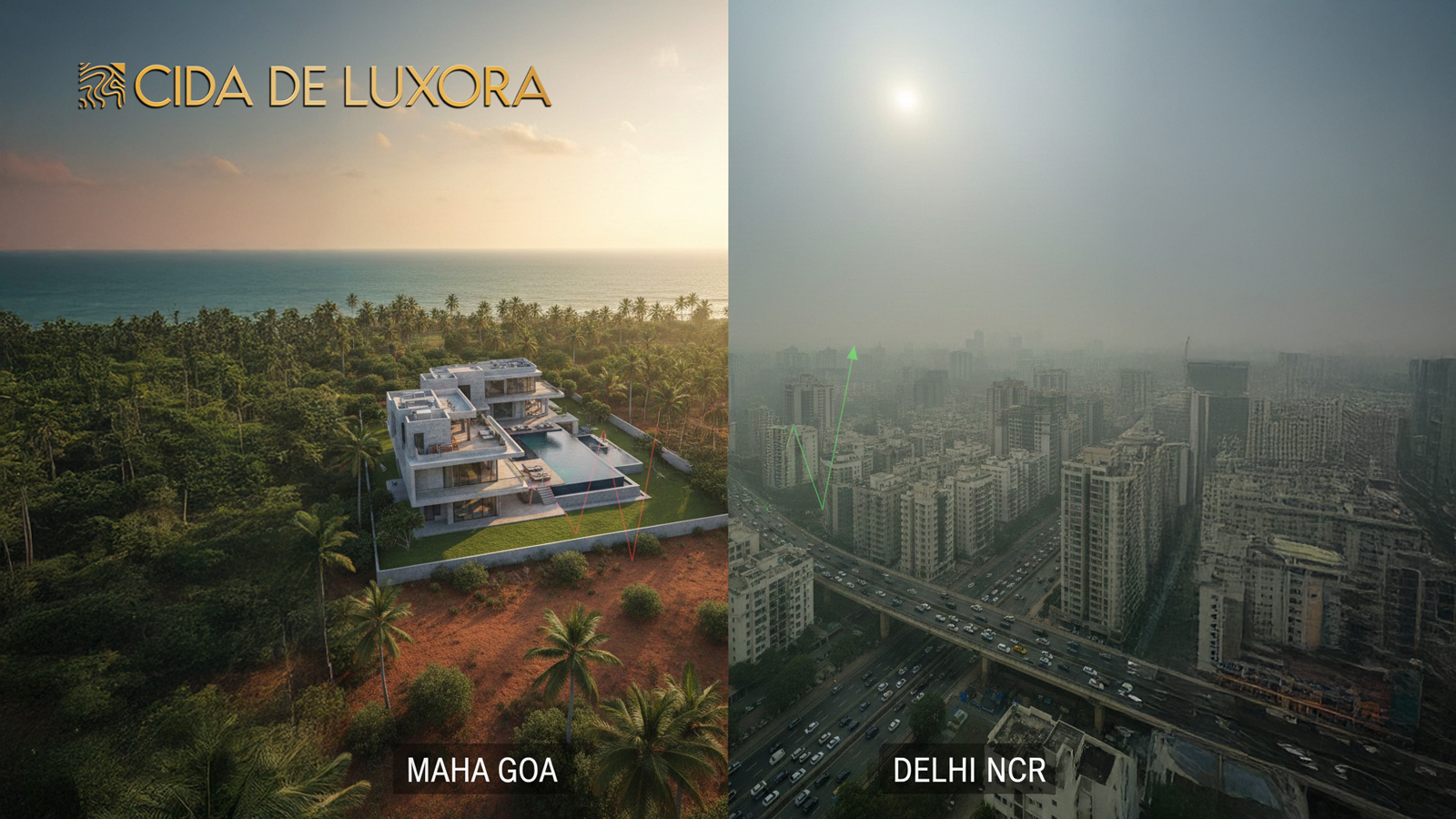
It is within this context that luxury villa plots in maha goa emerged not as a trend, but as a counter-strategy. A strategy against polluted density, compromised health, and shrinking personal space.
This blog is not about abandoning cities. It is about understanding what 2025 revealed through official data, government action, and lived reality — and why that revelation is permanently reshaping where serious buyers deploy capital.

2025 Didn’t “Feel” Polluted — It Was Officially Classified That Way
There is a tendency to dismiss pollution narratives as emotional exaggeration. 2025 eliminated that argument.
India’s Central Pollution Control Board (CPCB) operates the National Air Quality Index (AQI), which classifies air quality into six categories ranging from Good to Severe. These categories are not subjective; they are linked to defined health impacts and policy triggers.
According to the CPCB’s National AQI Portal, large parts of Delhi NCR repeatedly entered the “Very Poor” (301–400 AQI) and “Severe” (401–500 AQI) categories during 2025 winter months.
To put this into perspective:
- Very Poor air can cause respiratory illness even in healthy individuals.
- Severe air impacts everyone, with prolonged exposure increasing health risks substantially.
What alarmed policymakers — and residents — was not just how high the AQI climbed, but how long it stayed elevated.
This persistence forced the Commission for Air Quality Management (CAQM) to repeatedly invoke the Graded Response Action Plan (GRAP) — a set of emergency restrictions designed to limit further deterioration.
These measures included:
- Construction bans
- Vehicular restrictions
- Advisories limiting outdoor exposure
- School and activity restrictions
When emergency frameworks become routine, it signals a structural problem.
This is the first domino that pushed many families and investors to explore luxury villa plots in maha goa as part of a long-term environmental hedge.
Why Delhi NCR Keeps Suffocating: The Geography Problem No Policy Can Fix
Air pollution is often framed as a failure of enforcement. That is only part of the story.
Government-backed research from the Ministry of Earth Sciences (MoES) and the IITM-led Air Quality Early Warning System for Delhi highlights a deeper challenge — meteorology and geography.
Delhi NCR is a landlocked basin. During winter:
- Cold air settles close to the ground
- Warm air forms a layer above
- Wind speeds drop sharply
This creates temperature inversion, effectively trapping pollutants near ground level. Even if emissions drop temporarily, dispersion remains limited.
Official early warning bulletins from MoES consistently link high AQI episodes to these meteorological conditions.
This means that pollution is not merely a function of “bad days.” It is a predictable seasonal pattern reinforced by geography.
From an investor’s lens, this matters enormously.
Some regions recover naturally after stress events. Others accumulate stress.
When buyers evaluate luxury villa plots in maha goa, they are responding to this distinction — choosing regions where environmental recovery is structurally possible.
The Silent Drain: Health, Lifestyle, and Productivity Loss
Air pollution’s most damaging cost is not immediate hospitalization. It is slow erosion.
The World Health Organization (WHO) updated its Global Air Quality Guidelines in 2021, drastically lowering acceptable PM2.5 exposure thresholds based on global health evidence.
The WHO is unequivocal:
There is no safe level of long-term PM2.5 exposure.
For urban families, this translates into:
- Reduced outdoor exercise
- Children confined indoors
- Elderly residents limiting movement
- Dependence on air filtration systems
- Psychological stress from restricted living
By 2025, air purifiers had become as essential as refrigerators in NCR households. Balconies were sealed. Morning walks vanished. Outdoor cafés emptied.
These adaptations come with financial and emotional costs.
In contrast, luxury villa plots in maha goa offer an alternative: open living without constant defensive planning.
Why Coastal Regions Behave Differently (Without Making Unrealistic Claims)
It is important to avoid exaggeration. Coastal regions are not immune to pollution. But they function differently.
Environmental studies consistently show that sea–land breeze circulation enhances pollutant dispersion compared to stagnant inland regions. Wind flow does not eliminate emissions, but it prevents prolonged accumulation.
This is why coastal belts often experience:
- Faster AQI recovery
- More usable outdoor hours
- Better natural ventilation
Maha Goa benefits from this coastal dynamic while maintaining lower industrial density than major metros.
For buyers evaluating luxury villa plots in maha goa, this does not mean “perfect air.” It means resilient air — air that recovers, circulates, and supports outdoor living.
The Rise of Maha Goa: Not Goa, Not Maharashtra — But Both
“Maha Goa” is emerging as a distinct investment geography.
As core Goa markets became saturated, expensive, and tightly regulated, buyers began looking just beyond — into Maharashtra’s coastal belt that retains Goa’s ecological character without its congestion.
This region offers:
- Proximity to Goa’s lifestyle ecosystem
- Cleaner air cycles
- Lower population density
- Larger land parcels
- Controlled development potential
Unlike speculative apartments, luxury villa plots in maha goa provide ownership of land — a finite resource — with flexibility in design, ventilation, and use.
This combination has made Maha Goa particularly attractive to:
- NCR professionals
- Business owners
- Retired HNIs
- Second-home buyers seeking year-round usability
Why Villa Plots Matter More Than Ever After 2025
Apartments are efficient. Villa plots are liberating.
Urban apartments prioritise density. They sacrifice:
- Cross-ventilation
- Green buffers
- Personal outdoor space
In contrast, luxury villa plots in maha goa allow:
- Courtyards and gardens
- Cross-breeze architecture
- Open terraces
- Low neighbour density
- Personalised wellness design
Post-2025, this control over one’s environment has become a defining luxury.
2025 Changed How Investors Define “Returns”
Historically, real estate returns were measured in:
- Capital appreciation
- Rental yield
In 2025, a third metric emerged:
- Quality of life yield
Investors began asking:
- Will I enjoy living here?
- Will this asset age well environmentally?
- Will demand for cleaner living increase?
In this framework, luxury villa plots in maha goa are not speculative bets. They are defensive assets against urban deterioration.
A Deeper Investor Lens: Why Maha Goa Aligns with Long-Hold Strategy
From a capital allocation perspective, Maha Goa ticks multiple boxes:
- Land scarcity — coastal plots are finite
- Lifestyle demand — cleaner air is non-negotiable
- Customisation — build-to-suit villas
- Lower volatility — end-user driven demand
- Legacy value — intergenerational usability
Unlike apartments that depreciate structurally, land retains intrinsic value.
This is why luxury villa plots in maha goa are increasingly positioned as legacy investments, not flip opportunities.
Buyer Checklist: Before Investing in Luxury Villa Plots in Maha Goa
Serious buyers must evaluate:
- Clear land title and approvals
- Gated community planning
- Water sustainability
- Road and highway access
- Flood-risk assessment
- Plot orientation for ventilation
- Developer credibility
- Maintenance framework
- Exit liquidity
- Long-term infrastructure visibility
Diligence transforms luxury villa plots in maha goa into stable assets.
2026 and Beyond: Clean Air Is the New Currency
2025 did not create a new desire. It clarified an old truth.
Health, space, and air quality are not luxuries. They are foundational assets.
As cities grow denser and pollution cycles repeat, regions that offer environmental resilience will command a premium.
In this new reality, luxury villa plots in maha goa stand at the intersection of:
- Clean-air recovery
- Coastal resilience
- Land ownership
- Lifestyle sovereignty
Luxury is no longer defined by interiors alone.
It is defined by how freely you live outside them.
FAQs
1. Why are luxury villa plots in Maha Goa gaining attention after 2025?
Interest in luxury villa plots in maha goa surged after 2025 because air quality shifted from being a lifestyle concern to a long-term health and investment risk. Repeated “Very Poor” and “Severe” AQI episodes in Delhi NCR, officially recorded by the Central Pollution Control Board (CPCB), made pollution a structural reality rather than a seasonal inconvenience.
Maha Goa’s coastal geography allows better air dispersion, lower stagnation, and more outdoor-friendly living compared to landlocked metros. For investors, this represents a defensive shift — moving capital toward regions that support longevity, wellness, and sustained demand.
2. How does Maha Goa’s air quality compare to Delhi NCR officially?
Delhi NCR frequently enters “Very Poor” and “Severe” AQI categories during winter months, which trigger government emergency actions under GRAP (Graded Response Action Plan). These classifications are based on CPCB’s official AQI framework.
Maha Goa, while not pollution-free, benefits from coastal ventilation and lower industrial density, reducing prolonged stagnation events. This difference is critical for people considering luxury villa plots in maha goa for year-round living rather than occasional use.
3. Is air pollution really a long-term health risk or just a seasonal issue?
According to the World Health Organization (WHO), there is no safe level of long-term exposure to PM2.5 air pollution. Even moderate but prolonged exposure increases risks related to respiratory, cardiovascular, and overall health.
This global health consensus is a major reason why families are prioritising luxury villa plots in maha goa — not for short stays, but as long-term living and legacy assets
4. Why does Delhi NCR experience recurring winter smog despite restrictions?
Government-backed research from the Ministry of Earth Sciences (MoES) explains that Delhi NCR suffers from temperature inversion and low wind speed during winters, which traps pollutants close to the ground.
This means that even when emissions are reduced, dispersion remains poor. Official early warning bulletins repeatedly confirm this meteorological pattern — making pollution a recurring structural issue.
This reality is driving demand for luxury villa plots in maha goa, where geography allows better natural ventilation.
5. Are luxury villa plots in Maha Goa suitable for full-time living or only second homes?
Unlike purely tourist-driven destinations, Maha Goa is increasingly being planned for full-time residential living. Gated developments, improved road connectivity, and social infrastructure make luxury villa plots in maha goa viable for year-round occupancy.
Many buyers today design villas with work-from-home spaces, wellness zones, and sustainable utilities — transforming plots into primary residences rather than holiday homes.
6. Why are villa plots preferred over apartments in the post-2025 context?
Apartments are designed for density efficiency. Villa plots are designed for environmental control.
After 2025, buyers realised that:
- Cross-ventilation
- Open green space
- Personal outdoor areas
are not aesthetic luxuries but health necessities. Luxury villa plots in maha goa allow custom-built homes with airflow-focused architecture — something vertical apartments cannot offer.
7. Is investing in Maha Goa safer than investing in saturated urban markets?
From a long-hold perspective, yes. Urban apartment markets face:
- High density
- Infrastructure strain
- Environmental stress
- Faster structural depreciation
In contrast, luxury villa plots in maha goa are land-led assets. Land scarcity, coastal regulation, and end-user demand provide lower volatility and stronger legacy value.
8. What due diligence is important before buying luxury villa plots in Maha Goa?
Buyers should verify:
- Land title and approvals
- Gated community planning
- Water sustainability
- Flood-risk and topography
- Road connectivity
- Developer track record
Performing proper checks ensures that luxury villa plots in maha goa remain secure, compliant, and future-ready investments.
9. How does government data support the clean-living shift toward coastal regions?
Government agencies such as CPCB, MoES, and CAQM provide measurable evidence that:
- Landlocked regions face repeated pollution entrapment
- Coastal regions benefit from dispersion mechanisms
- Emergency responses are increasingly frequent in metros
This data-driven clarity has validated the shift toward luxury villa plots in maha goa as part of informed, health-conscious investing.
10. Will demand for luxury villa plots in Maha Goa continue beyond 2026?
Yes — because the drivers are structural, not cyclical.
Air quality, population density, wellness-driven living, and land scarcity are long-term forces. As urban pollution challenges persist, regions offering environmental resilience will continue to attract buyers.
This positions luxury villa plots in maha goa as enduring assets rather than trend-based investments.
2025 Changed the Question. 2026 Demands an Answer.
For years, real estate decisions were driven by price charts and appreciation curves.
2025 introduced a deeper metric — how well a place supports life itself.
If the past year taught us anything, it is this:
- Clean air is not guaranteed
- Space is not replaceable
- Land is not infinite
Luxury villa plots in maha goa represent more than ownership. They represent control — over space, design, ventilation, and lifestyle. They offer the freedom to build homes that breathe, environments that recover, and legacies that endure.
At Cida De Luxora, this philosophy is translated into a carefully planned, ultra-luxury gated ecosystem:
- Limited-edition villa plots
- Roman-inspired master planning
- Integrated retail and office spaces
- Strategic coastal connectivity
- Security, sustainability, and long-term vision
This is not about escaping the city.
It is about outgrowing its limitations.
👉 Explore available luxury villa plots in Maha Goa
👉 Request the master plan, plot sizes, and legal documentation
👉 Schedule a private site visit and experience the difference firsthand
Because the next decade will reward those who invested not just in property —
but in liveability, longevity, and land.