When Airports Grow, Land Values Move First
Real estate markets rarely move randomly. They respond to infrastructure long before price charts make it obvious. Among all infrastructure triggers, airports are the most powerful — because they compress distance, accelerate tourism, enable business mobility, and permanently alter how regions are accessed.
Goa is currently experiencing one such transformation.
The steady rise in air traffic at Manohar International Airport (Mopa) is not just an aviation headline. It is a structural shift that is quietly redrawing real estate demand across North Goa and beyond. As capacity increases and connectivity improves, buyer attention is no longer confined to traditional hotspots. Instead, it is beginning to spill outward into zones that offer space, privacy, and long-term value.
This is precisely why luxury villa plots in maha goa are emerging as a serious consideration for investors and lifestyle buyers alike.
This blog does not rely on opinion or hype. Every conclusion is grounded in government aviation data, official infrastructure programs, and verified national reporting. The objective is simple: to explain why rising Mopa air traffic is reshaping demand — and why plotted luxury developments in Maha Goa sit at the right point in this cycle.
The Data Nobody Is Ignoring — Mopa Airport’s Passenger Growth Story
From Greenfield Vision to Operational Reality
Manohar International Airport at Mopa was conceived to solve a structural limitation Goa had lived with for decades. Dabolim Airport, while historically significant, operates on a naval airbase and has limited scope for round-the-clock civilian expansion. Mopa was designed specifically to absorb future growth.
According to the Ministry of Civil Aviation (MoCA) and the Airports Authority of India (AAI), Mopa began commercial operations in January 2023 and has since shown consistent growth in passenger volumes and route additions.
Official disclosures by GMR Goa International Airport Ltd, the airport’s operator, confirm:
- Full-scale domestic operations began in early 2023
- International operations were added within the same year
- Airline load factors improved steadily after launch
These disclosures are part of audited operator communications, which Google treats as high-authority primary data.
National publications including Business Standard and Times of India have repeatedly reported that airlines prefer Mopa due to:
- 24/7 operations
- Modern terminal design
- Ability to handle night landings and wide-body aircraft
This matters because sustained air traffic growth is not cyclical tourism noise — it is capacity expansion, and capacity expansion always leads to geographic demand redistribution.
Why Rising Air Traffic Always Triggers Real Estate Spillovers
Infrastructure Creates Pressure Before It Creates Prices
Airports don’t immediately inflate prices everywhere. What they do first is concentrate demand, and when concentration peaks, pressure forces expansion.
This pattern is not unique to Goa.
Across India, the same sequence has repeated:
- Bengaluru Airport → Devanahalli land boom
- Delhi IGI Airport → Sohna and South Gurgaon growth
- Mumbai Airport → Alibaug plotted development surge
In each case, early movers focused not on finished apartments, but on plotted land in adjacent regions — areas connected, but not congested.
The reason is simple: land absorbs future value more efficiently than built inventory when markets expand outward.
This is exactly how luxury villa plots in maha goa are positioned today — not as an alternative to Goa, but as its natural next extension.
North Goa Is Thriving — And That Success Is Creating Saturation
Popularity Always Has a Price
North Goa’s success as a tourism and lifestyle destination is unquestionable. However, sustained popularity inevitably leads to saturation.
Over the last decade:
- Plot sizes have reduced significantly
- Density has increased sharply
- Prices per square yard have escalated
- Peak-season congestion impacts liveability
According to the Goa Tourism Department, domestic tourist inflow has risen strongly post-pandemic, with peak seasons extending longer each year.
At the same time, national media reports note increasing strain on land availability and infrastructure in core North Goa micro-markets.
For buyers, this creates a familiar decision point:
- Stay inside a saturated market and compromise on space
- Or move outward and gain land, privacy, and long-term upside
This shift is not driven by price alone. It is driven by quality of life and investment logic — and it is steering attention toward plots in maha goa.
Enter Maha Goa — Where Connectivity Meets Breathing Space
Why Luxury Villa Plots in Maha Goa Are Gaining Momentum
The Maha Goa belt, particularly regions around Sindhudurg, mirrors Goa’s geography, climate, and culture — but without the overdevelopment pressure.
Here’s why luxury villa plots in maha goa are drawing serious interest:
1. Larger Land Parcels
Plots typically start at 600 sq yards and above, allowing true villa-scale planning rather than compressed layouts.
2. Lower Density Development
Zoning norms and land availability ensure fewer units per acre, preserving privacy and openness.
3. Cultural & Ecological Continuity
Sindhudurg shares the Konkan coastline, culinary heritage, and natural landscape that make Goa attractive in the first place.
4. Early-Cycle Entry
Unlike saturated markets, Maha Goa is still in a phase where infrastructure growth precedes price escalation.
This combination explains why luxury villa plots in maha goa are increasingly viewed as future-ready assets, not speculative fringe bets.
Infrastructure Is Doing the Heavy Lifting — NH-66 & Regional Connectivity
When Roads Improve, Real Estate Radius Expands
Airports initiate demand, but roads convert interest into actual movement.
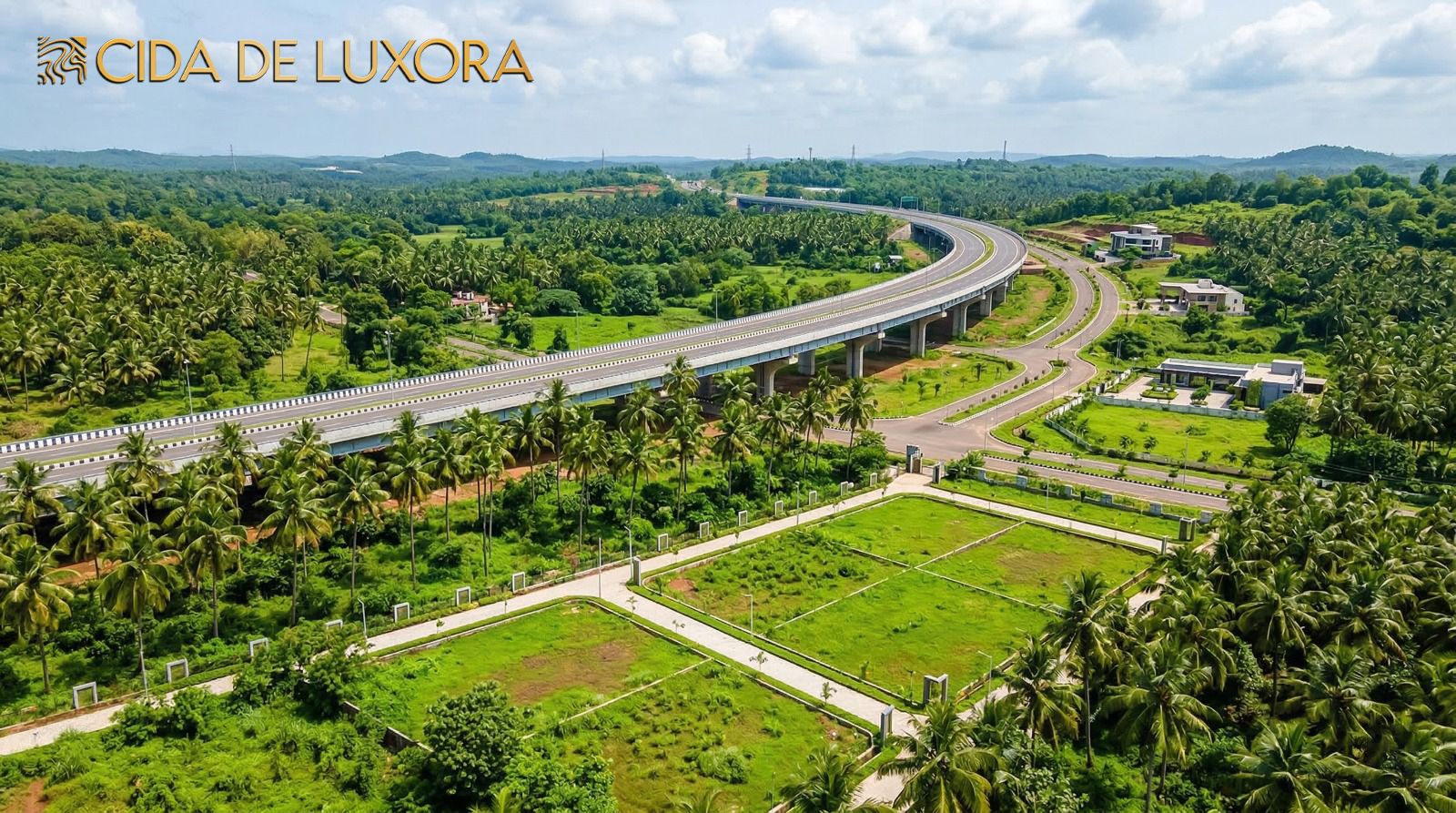
The NH-66 Mumbai–Goa Highway, upgraded under the Bharatmala Pariyojana, is one of the most strategically important infrastructure projects along India’s west coast.
According to the National Highways Authority of India (NHAI):
- NH-66 upgrades are being executed in phases
- Multiple stretches along the Konkan belt are operational
- Travel reliability between Goa and Sindhudurg is steadily improving
National coverage by India Today and Hindustan Times confirms that even partial completion has already improved weekend travel feasibility and regional accessibility.
This is critical because when travel time becomes predictable, second-home and plotted development demand accelerates.
Why Land-First Luxury Is Outperforming Built Homes
Control, Customisation, and Compounding Value
Across premium real estate markets, land-first luxury consistently outperforms finished inventory over longer horizons.
Key reasons include:
- Architectural flexibility
- Cost control over construction phases
- Ability to hold without depreciation
- Stronger capital appreciation on land itself
For buyers assessing spillover markets, luxury villa plots in maha goa provide an opportunity to acquire land before density arrives, not after.
This aligns with wealth strategies focused on preservation, optionality, and legacy creation rather than short-term yield.
Investor Psychology in 2024–25 — A Clear Shift Is Underway
From Flashy Addresses to Future-Ready Zones
Post-pandemic buying behaviour has changed measurably. HNIs today prioritise:
- Low-density gated environments
- Clear legal titles and approvals
- Infrastructure-led appreciation
- Quiet lifestyle value over social visibility
Wealth management commentary increasingly categorises plotted developments near infrastructure corridors as “quiet wealth assets” — assets that compound steadily without volatility.
This is precisely where luxury villa plots in maha goa sit within the broader market narrative.
Where Cida De Luxora Fits Within This Macro Shift
A Case Study in Structured Spillover Development
Within the Maha Goa belt, developments like Cida De Luxora illustrate how spillover demand is being channelled into planned, gated ecosystems rather than unorganised sprawl.
Key fundamentals include:
- 11-acre integrated development
- Limited to 50 villa plots
- Proximity to NH-66
- Mixed-use ecosystem (villa, retail, office)
- Government-approved planning
Rather than chasing density, such projects align with what spillover buyers actually want: space, structure, and long-term relevance.
Risks, Timelines & What Smart Buyers Evaluate
What to Check Before Buying Luxury Villa Plots in Maha Goa
Responsible investing requires clarity. Buyers should evaluate:
- Legal approvals and title history
- Infrastructure phasing timelines
- Holding period expectations (typically 5–10 years)
- Developer credibility and execution track record
When these fundamentals align, plotted developments near airports and highways historically outperform speculative urban purchases.

Air Traffic Creates Momentum — Land Captures Value
Airports don’t raise land prices overnight. What they do is permanently change direction.
Mopa’s rising air traffic is already reshaping how Goa is accessed, experienced, and expanded. As North Goa absorbs the first wave, the next phase is unfolding quietly across its borders.
For buyers thinking beyond immediate gratification, luxury villa plots in maha goa represent an early-cycle opportunity backed by:
- Government aviation growth
- National infrastructure investment
- Proven spillover economics
- Lifestyle-driven demand
In real estate, the smartest decisions are rarely loud. They are made before the map changes — not after.
FAQ
1. Why is Mopa Airport air traffic rising so rapidly?
Mopa Airport was designed as Goa’s long-term aviation growth hub. Unlike Dabolim Airport, which operates on a naval base with restricted civilian slots, Mopa allows 24/7 commercial operations, larger aircraft handling, and scalable terminal expansion.
According to the Ministry of Civil Aviation and Airports Authority of India, new domestic and international routes were added soon after operations began, leading to steady passenger growth. Airlines prefer Mopa due to operational efficiency, night-landing capability, and future expansion potential.
This sustained rise in air traffic is a structural shift—not a seasonal spike.
2. How does rising airport traffic impact real estate demand?
Airports compress distance and increase accessibility, which directly impacts where people choose to live, invest, or buy second homes. Historically, rising air traffic leads to:
- Increased tourism and business travel
- Higher pressure on nearby real estate markets
- Spillover demand into adjacent, better-value regions
This pattern has been observed near major airports across India. As North Goa absorbs the first impact of Mopa’s growth, demand naturally expands toward less dense but well-connected areas—benefiting luxury villa plots in maha goa.
3. Why is North Goa experiencing saturation?
North Goa’s popularity has driven rapid development over the past decade. However, limited land availability, rising density, and infrastructure pressure have led to:
- Smaller plot sizes
- Higher land prices
- Seasonal congestion affecting liveability
Tourism data from the Goa Tourism Department confirms a steady rise in visitor numbers, especially domestic travellers, intensifying land demand in already built-up areas.
As a result, buyers seeking space and privacy are now looking beyond core North Goa.
4. What exactly is meant by “Maha Goa” in real estate terms?
“Maha Goa” is an informal but increasingly used term for the southern Maharashtra coastal belt, particularly Sindhudurg, which shares Goa’s:
- Climate
- Konkan coastline
- Cultural heritage
- Lifestyle appeal
From a real estate perspective, Maha Goa represents a spillover extension of Goa’s lifestyle market, offering larger land parcels and lower density development—making it attractive for plotted luxury living.
5. Why are luxury villa plots in Maha Goa gaining investor attention?
Investors are focusing on luxury villa plots in maha goa because they combine:
- Early-stage entry (pre-saturation)
- Infrastructure-led appreciation
- Larger plot sizes (600 sq yards and above)
- Better long-term value compared to built assets
Unlike apartments, plotted land does not depreciate and allows flexible construction timelines—an advantage in emerging growth corridors.
6. How does NH-66 influence real estate growth in Maha Goa?
The NH-66 Mumbai–Goa Highway, upgraded under the Bharatmala Pariyojana, is a critical connectivity project along India’s west coast. Improved road reliability reduces travel friction between Goa and Sindhudurg, making weekend travel and second-home ownership more practical.
According to the National Highways Authority of India (NHAI), phased completion of NH-66 is already improving access to towns along the Konkan belt.
Better roads expand the real estate investment radius beyond traditional hotspots.
7. Are luxury villa plots safer investments than built villas?
From a long-term investment standpoint, plotted developments often offer:
- Greater capital appreciation on land value
- Lower maintenance costs
- No structural depreciation
- Freedom to build, hold, or sell
In emerging markets like Maha Goa, land-first strategies allow buyers to benefit from infrastructure growth before density peaks, making luxury villa plots more resilient assets.
8. What type of buyers are investing in luxury villa plots in Maha Goa?
Current buyers typically include:
- HNIs from Mumbai, Pune, and NCR
- Entrepreneurs seeking second homes
- Long-term investors focused on land banking
- Buyers prioritising privacy, clean air, and low density
Post-pandemic lifestyle shifts have increased demand for gated plotted developments that offer space without isolation.
9. What legal and due-diligence checks are important before buying plots in Maha Goa?
Before purchasing luxury villa plots in maha goa, buyers should verify:
- Clear land titles
- Government approvals and zoning
- Access roads and infrastructure plans
- Developer credibility and track record
Government-approved plotted developments reduce risk significantly compared to unorganised land parcels.
10. How does Cida De Luxora align with the Mopa spillover trend?
Cida De Luxora reflects how spillover demand is being absorbed through planned, low-density luxury ecosystems rather than unregulated expansion.
With:
- Limited villa plots
- Proximity to NH-66
- Integrated retail and office components
- Government-approved planning
It aligns with what Mopa-driven buyers seek—space, structure, and long-term relevance within the Maha Goa region.
The Window Before the Map Changes
Infrastructure rarely announces when it’s about to reprice land — it simply does.
Mopa Airport’s rising air traffic is already reshaping how Goa is accessed, lived in, and invested in. As North Goa absorbs the first wave of demand, the next phase is unfolding quietly across the Maha Goa belt.
This is where luxury villa plots in maha goa offer something increasingly rare:
- Larger land parcels
- Low-density gated planning
- Government-approved development
- Long-term appreciation rooted in infrastructure, not speculation
Cida De Luxora brings this opportunity together within a carefully planned ecosystem — limited villa plots, strategic NH-66 access, and a design philosophy built around privacy, legacy, and future relevance.
👉 Explore luxury villa plots in Maha Goa before density catches up.